
The Chinese-speaking art world in northern Germany: We open our doors. As a group of seven women from China, Germany and Switzerland working across art and culture, we have found our home in a historic wooden house by the lake Ihlsee in Bad Segeberg. Here, we invite you in – for residencies, exhibitions and talks, to be a part of our community.
Our focus is on artists from and with connections to the Chinese-speaking world: At a time of social unrest and growing global tensions, we turn our gaze towards Asia. In the face of political differences, we seek to foster personal encounters and direct exchange. Art, with its ambivalent voices, is perfect for this. We are working with “Ihlsee as Method”.*
* We follow the approach of “Asia as Method” and, in particular, “China as Method” – understanding Asia and China not merely as geographical entities, but as spaces of convergence shaped by a shared cultural, historical and worldview framework. We regard the Western perspective as one among many. See, for example, Mizoguchi Yūzō: “China as Method”, in: Inter-Asia Cultural Studies, January 2016, 17(4), pp. 513–518.
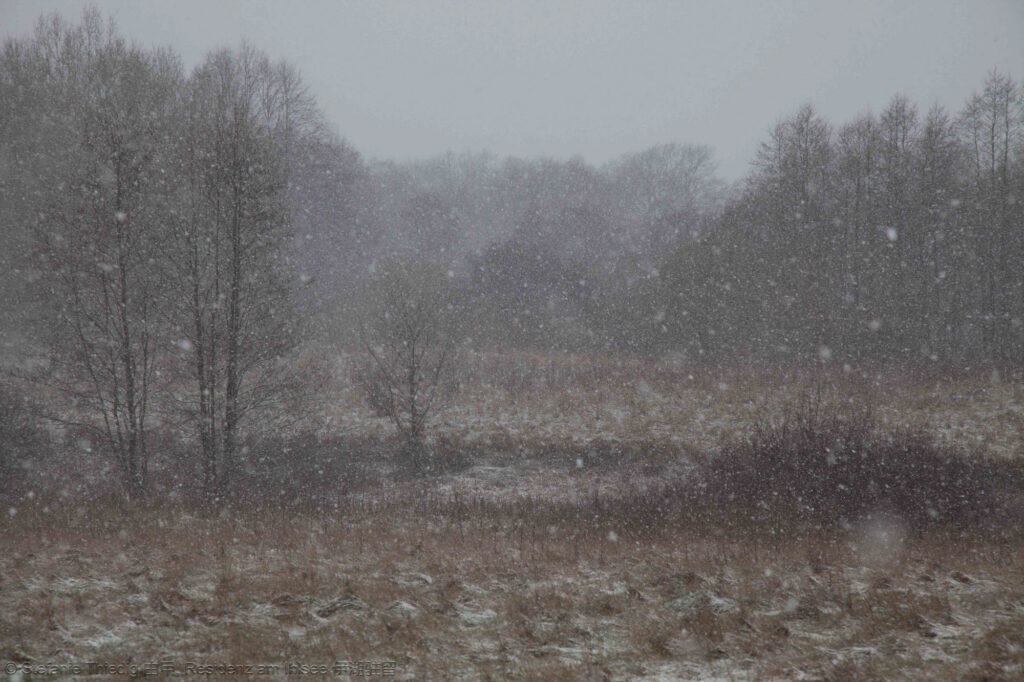
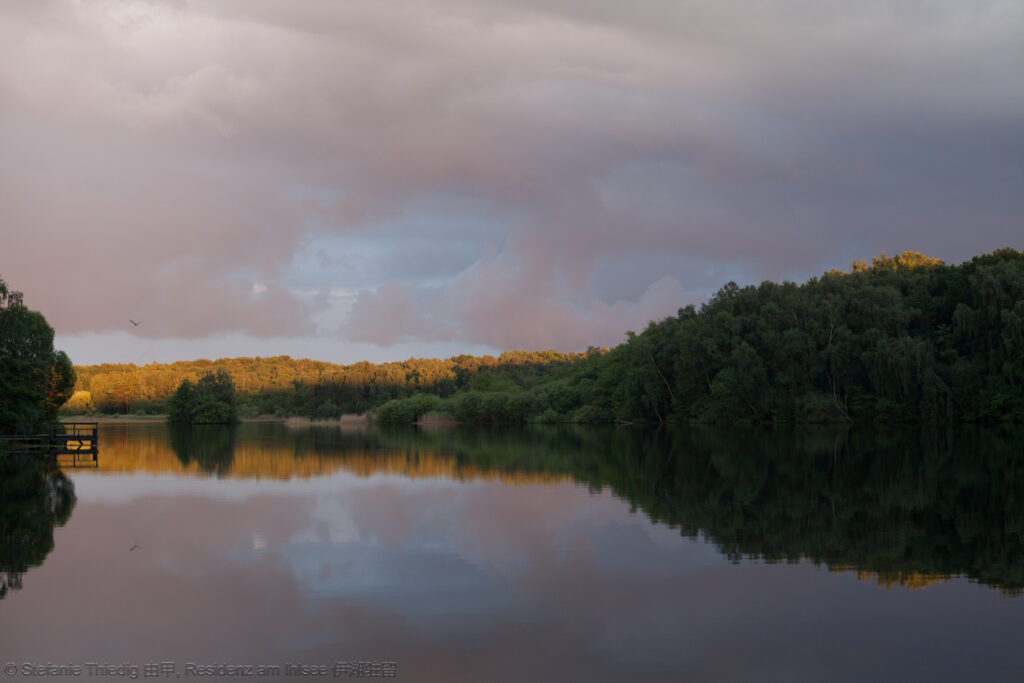
Between the blue of the Ihlsee and the green of the Ihlwald, art finds its space – in all its colours, shades and possibilities.
In Chinese, there is a word for a colour that shifts between blue and green: 青 (qīng). It can evoke the blue of water, the green of leaves, the shades of jade – a colour that refuses to settle neatly into one category. English and German have no exact equivalent. The word itself opens up another way of seeing and becomes a reminder that colours, like ideas, are shaped by language and culture.
At our residency, blue and green meet – water and forest, openness and insight. And in this meeting, art offers a means of looking beyond familiar boundaries: of seeing differently, and of discovering that the world can be named, imagined and understood in many forms.
The landscape itself carries an intriguing history. During the Weichselian Glaciation, around 13,000 years ago, a glacier swept across the hill country of East Holstein at the edge of the Segeberg Forest, shaping the landscape over millennia into what would eventually become the Ihlsee, one of the most beautiful lakes in northern Germany.
With a depth of 21 metres and covering just under 30 hectares, a three-kilometre circular trail leads through sandy woodland in the north and marshy floodplains in the southern swamp forest. Due to the lack of lime and nutrients, the lake remains clear and flooded with light even at greater depths; its sandy and gravelly bed provides a habitat for rare plant species that are almost extinct in Schleswig-Holstein. On summer evenings in particular, you can see pond bats fluttering over the lake.
Ihlsee and Ihlwald have been protected as a nature reserve since 1950. In this landscape, on the shores of the Ihlsee and in the midst of Ihlwald, sits a small cottage.
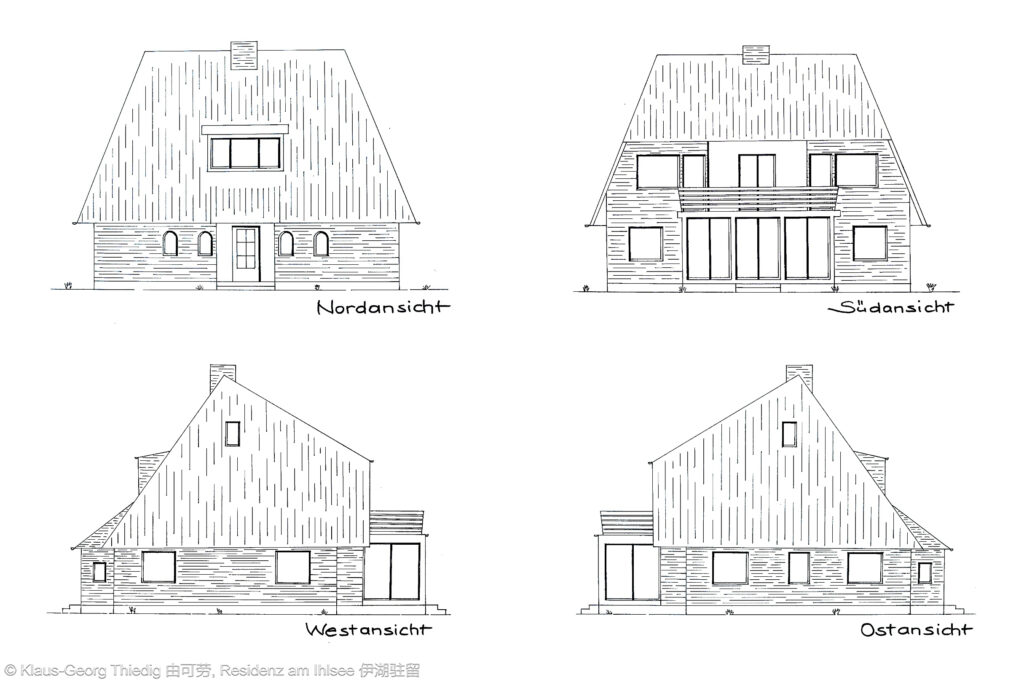
The lot is 1,700sqm in size, with direct access to the lake and plenty of space for gardening. The house itself occupies around 85–90sqm, with approximately 135sqm of floor space.
We have three residency rooms available: two are spacious, while the third is smaller. All three are on the first floor, are not accessible to wheelchair users, share one bathroom and have private access to our terrace. There is also a spare guest room on the ground floor, which is barrier-free, as well as a second bathroom. The ground floor has an open kitchen and a large communal and working space – and an amazing sunroom. Then there is the attic, wooden from floor to ceiling, which we imagine to be perfect for intimate exhibitions.
Built in 1939, the history of the house begins in a dark chapter in German history. Lake Ihlsee, belonging to the village of Klein Niendorf, was incorporated into the town of Bad Segeberg in 1937. This took place during the Nazi period, when Segeberg and its inhabitants displayed thoroughly disgraceful behaviour towards their Jewish fellow citizens, looting their property and setting fire to it. This was presumably fuelled by the fact that Goebbels passed through here a few months later to inaugurate the “Thingstätte” of what is now the open-air theatre on the Kalkberg (hill of chalk) in the town centre.
Built as a holiday home for a timber merchant from Hamburg, the house was partially destroyed by fire and rebuilt in 1965, remaining inhabited until 2005. Since the early 2010s, it has been subject to protection of existing stock (Bestandsschutz in German), which means that the outer shell – the parts visible from the outside – must be preserved. Renovation work on the old cottage began at the end of 2022 and will be completed in summer of 2027.
Ideally, an artist has a studio of her own. But even then, a change of scenery and time away can benefit both perspective and everyday routines. At Ihlsee, residents are to find a refuge where they can breathe, pause and work with focus. At the same time, we open paths into the communities of the immediate neighbourhood, the town of Segeberg, Schleswig-Holstein and Hamburg, and way beyond. Through regular exhibitions, presentations and talks that may flow into shared celebrations, we want to involve and enrich the surrounding community. We firmly believe that both sides stand to benefit. A small collection of works – pieces that residents may leave behind in fragments – will create an additional connection between the artists and the place.
In 2039, we are looking forward to celebrating the 100th anniversary of our cottage: By then a place where ideas have taken root in the house and its landscape, growing and changing through the people and encounters it has gathered along the way, with space for many more stories to unfold. Come along and dive in!
© Residenz am Ihlsee e. V., 2026. All rights reserved. Alle Rechte vorbehalten. 版权所有。
Imprint | Impressum | 版本说明